A student stopped mid Down Dog last month, tilted her head at my feet, and asked -- straight up, in front of eleven other people -- "hey, is your big toenail supposed to look like that?" Barefoot studio. Mirrors on three walls. Nowhere to hide. That's the moment I finally sat down and built an actual system for foot care instead of vibes and whatever tea tree oil I'd been dabbing on for three months with zero results. Here's the checklist I wish someone had handed me back then, except I went one step further and traced every number below back to wherever it actually came from -- because half of what gets repeated in this space turns out to be made up the moment you check.
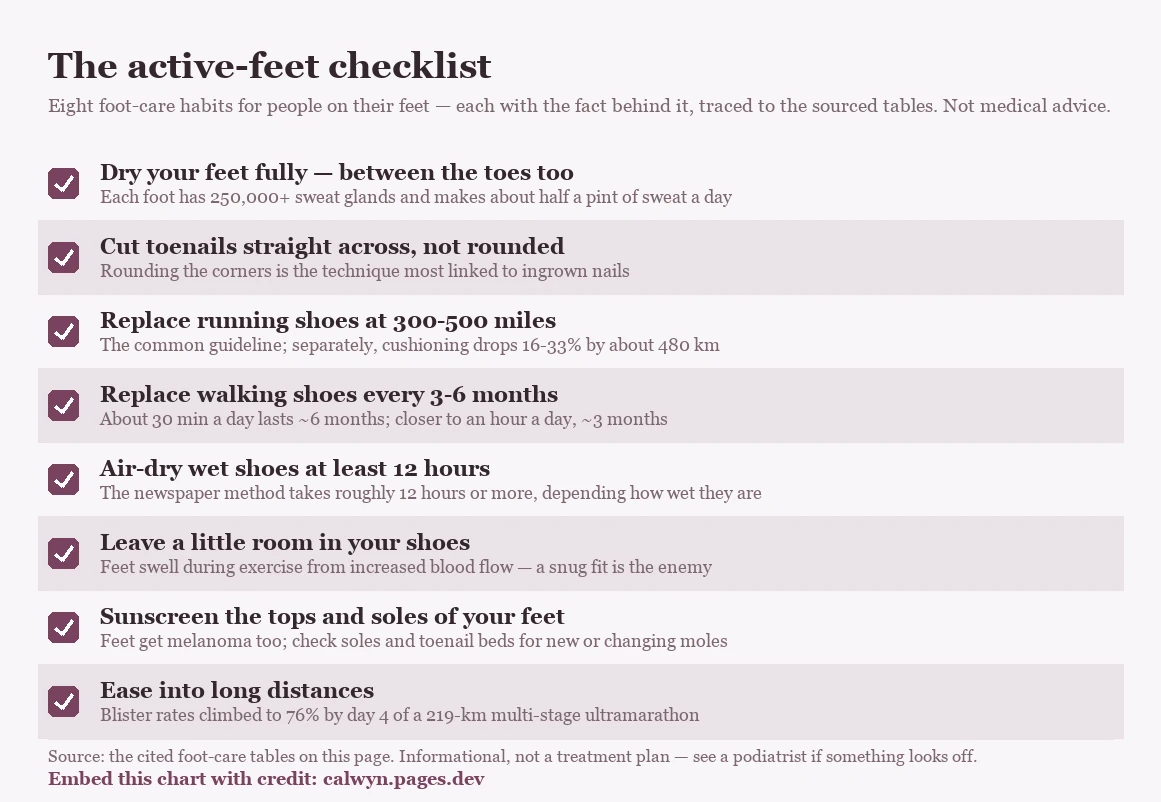
Two facts worth knowing before you shop for shoes: running shoes are generally recommended for replacement every 300-500 miles — and, separately, heel cushioning has been measured dropping 16-33% within about 480 km of running. Your feet also swell during exercise, so footwear needs a little room rather than a snug fit. (And the tops of your feet can burn: the ACFAS recommends sunscreen over the whole foot.)
Hygiene and Moisture Management
Sweat is the thing nobody warns you about when you teach barefoot six days a week. Studio floors get slick, the shower between back-to-back classes turns into a five-minute triage job, and yes -- I fell for the $28 "moisture-wicking" bamboo socks a running-store clerk swore by, and my feet were still swampy by the end of a 90-minute hot class. Here's what actually holds up when you dig into where the numbers came from:
| Component | Standard / Metric | Descriptive Data & Context |
|---|---|---|
| Daily Sweat Production | Roughly half a pint per foot, daily | Each foot contains over 250,000 sweat glands, the highest concentration in the human body, and produces about half a pint of sweat per day (Randell's Footcare). |
| Sock Material Absorption | 8% to 60% moisture retention | Alpaca fiber absorbs about 8% of its weight in moisture, versus roughly 30% for wool and 60% for cotton, per manufacturer-reported figures (Suri Performance Alpaca Socks). |
| Toenail Trimming Technique | Straight-across cut | Standard clinical guidance is to trim nails straight across, leaving corners resting loosely against the skin, rather than rounding them -- rounding is the technique most associated with ingrown nails (InformedHealth.org). |
| Athlete's Foot Prevalence | 10% to 15% of the population | Global prevalence estimates for tinea pedis (athlete's foot) run from about 10% (Wikidoc) to 15% (Wikipedia), depending on the population studied. |
Equipment and Footwear Maintenance
I'm not a runner, but half my students are, and my own hiking shoes rack up more mileage than I like to admit. Nobody replaces gear on a spreadsheet schedule -- I sure didn't, until my arches started complaining on a trail near Multnomah Falls and a physical-therapist friend asked how old my shoes were. I had no idea. That was the whole problem. Staying on top of this stuff works the same way a daily practice does on the mat: it's not one grand gesture, it's noticing the small wear before it turns into pain.
| Maintenance Item | Standard / Metric | Descriptive Data & Context |
|---|---|---|
| Running Shoe Replacement | 300 to 500 miles (500-800 km) | Running shoes are generally recommended for replacement every 300 to 500 miles (Nike); separately, heel cushioning has been found to drop 16% to 33% within about 480 km of running (RunRepeat). |
| Walking Shoe Replacement | 3 to 6 months | Walkers logging about 30 minutes daily typically need a new pair around the 6-month mark; closer to an hour a day shortens that to roughly 3 months (RunRepeat). |
| Drying Interval | At least 12 hours to air-dry | Air-drying with the newspaper method takes roughly 12 hours or more depending on how wet the shoes are (Nike). Rotating in a second pair so shoes dry fully between wears is a common tip; the idea that a "rest day" restores midsole cushioning, though, is debated and not well established. |
| Foot Expansion During Exercise | Temporary swelling, size varies | Increased blood flow during exercise causes temporary swelling in the feet and ankles, which is why footwear needs a little room to spare rather than a snug fit (Orange Insoles). |
Preventative Care and Injury Statistics
Blisters, bones, and sunscreen sound like an odd trio, but they're the three things I never thought about until they got personal. I got my first real blister on a retreat weekend, three miles into a barefoot beach walk I should have eased into slower. And the sunscreen thing -- I used to stop applying at my ankles every single time, like the tops of my feet were somehow exempt from the sun. Honestly, they are not, and neither are yours.
| Metric / Condition | Standard / Metric | Descriptive Data & Context |
|---|---|---|
| Friction Blister Incidence | 34% to 76% over a multi-day event | In a 5-day, 219-km multi-stage ultramarathon, blister incidence climbed from 34% after day 1 to 54% after day 2, 72% after day 3, and 76% by day 4 (PubMed). |
| Anatomical Composition | 26 bones per foot | Each foot contains 26 bones -- 52 across both feet -- which the American Academy of Orthopaedic Surgeons notes is nearly a quarter of all the bones in the human body (Rocky Mountain Foot & Ankle). |
| UV Exposure Risk | Melanoma susceptibility | The skin on the feet is highly susceptible to melanoma and other skin cancers; the American College of Foot and Ankle Surgeons recommends sunscreen over the whole foot and regular checks of soles and toenail beds for new or changing moles (Foot Health Facts). |
Quick honesty check before you go do anything on this page: I'm not a doctor, not a podiatrist, not any kind of medical professional -- just a yoga teacher who got humbled by her own toenail and went deep on the research afterward. Everything above is informational, not a treatment plan, and it doesn't replace an actual conversation with your podiatrist or doctor, especially if something looks off and isn't resolving on its own. And if you're managing diabetes, poor circulation, or any nerve damage in your feet, please loop in a professional before self-treating anything here -- small foot issues can turn serious a lot faster for that group than they do for the rest of us.
Last verified: 2026-07-12
Sources
- Randell's Footcare: Foot Sweat Data
- Suri Performance Alpaca Socks: Complete Guide to Moisture-Wicking Socks
- InformedHealth.org: Proper Toenail Trimming Techniques
- Wikidoc: Athlete's Foot Epidemiology
- Wikipedia: Tinea Pedis Overview
- Nike: Running Shoe Replacement Guidelines
- RunRepeat: Shoe Lifespan and Mileage Statistics
- Nike: Best Ways to Dry Shoes Without Damaging Them
- Orange Insoles: Why Do My Feet Change Size?
- PubMed: Blisters in Ultraendurance Runners (Scheer et al.)
- Rocky Mountain Foot & Ankle: Foot Anatomy Facts
- Foot Health Facts (ACFAS): Sunscreen on Your Feet